
Knowing Too Soon
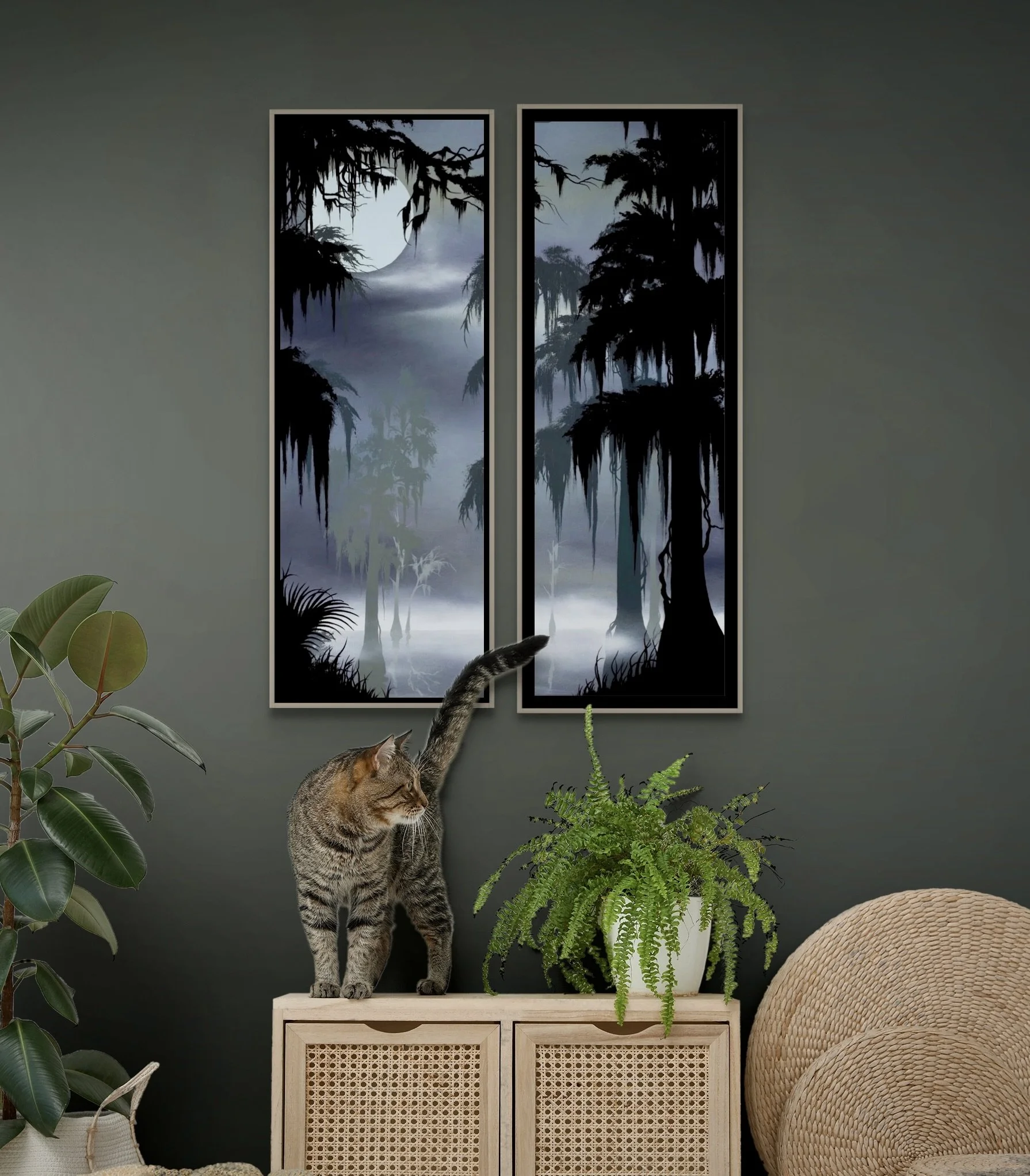
Night’s Drift giclee - diptych, (2)16x48”
Sometimes we simply know we love a piece of art.
It catches us immediately and refuses to let go. We circle back toward it across a gallery wall, pause in front of it longer than expected, or continue thinking about it long after we have left. Certain works pull us inward so completely that walking away from them feels less like moving on and more like a denial of something sparking within us.
Art has always existed this way. Since ancient times, art has been used to document human experience, belief, ritual, emotion, and the natural world around us. Images and symbols were left behind as evidence of how people understood themselves and the world they inhabited. As time has passed for thousands of years, the instinct and desire to make and experience art has remained. Collecting art is intrinsically part of human nature, and is one of the many ways we continue to participate in the world.
Yet, even when we know that we really love a piece, reality often interrupts that feeling. The wall may not feel right, or measurements are forgotten. A collector visiting from out of town may not know the dimensions of their home by memory. Framing becomes another question entirely. What begins as certainty slowly becomes hesitation.
At Tanner Gallery & Studio, we have found that many collectors do not need help deciding whether they love a work. Oftentimes, potential collectors simply need help bridging the desire for art with the practical reality of bringing the work home with them.
One of the ways we bridge that gap is through scaled virtual mockups using the same software often utilized by interior designers. By placing a work directly into a collector’s space to scale, along with different framing options, the process becomes less about guessing, or only existing within the gallery’s space. Virtual mockups allow for the confirmation that a work of art is a desire that is reachable, and that collecting art can feel like a natural indulgence rather than an impractical uncertainty.
Collecting art has never been about perfection, it has always been about connection. Sometimes, when viewing a painting, we know too soon, and the rest that follows becomes an anchor to trust the connection we feel toward it.